Timing
What Is the Outbound Moment? (And Why Timing Beats Generic Personalization)
Two hundred leads, watched by hand, and a 25%+ reply rate. Why outreach sent inside the narrow window after something changes beats any amount of generic personalization.
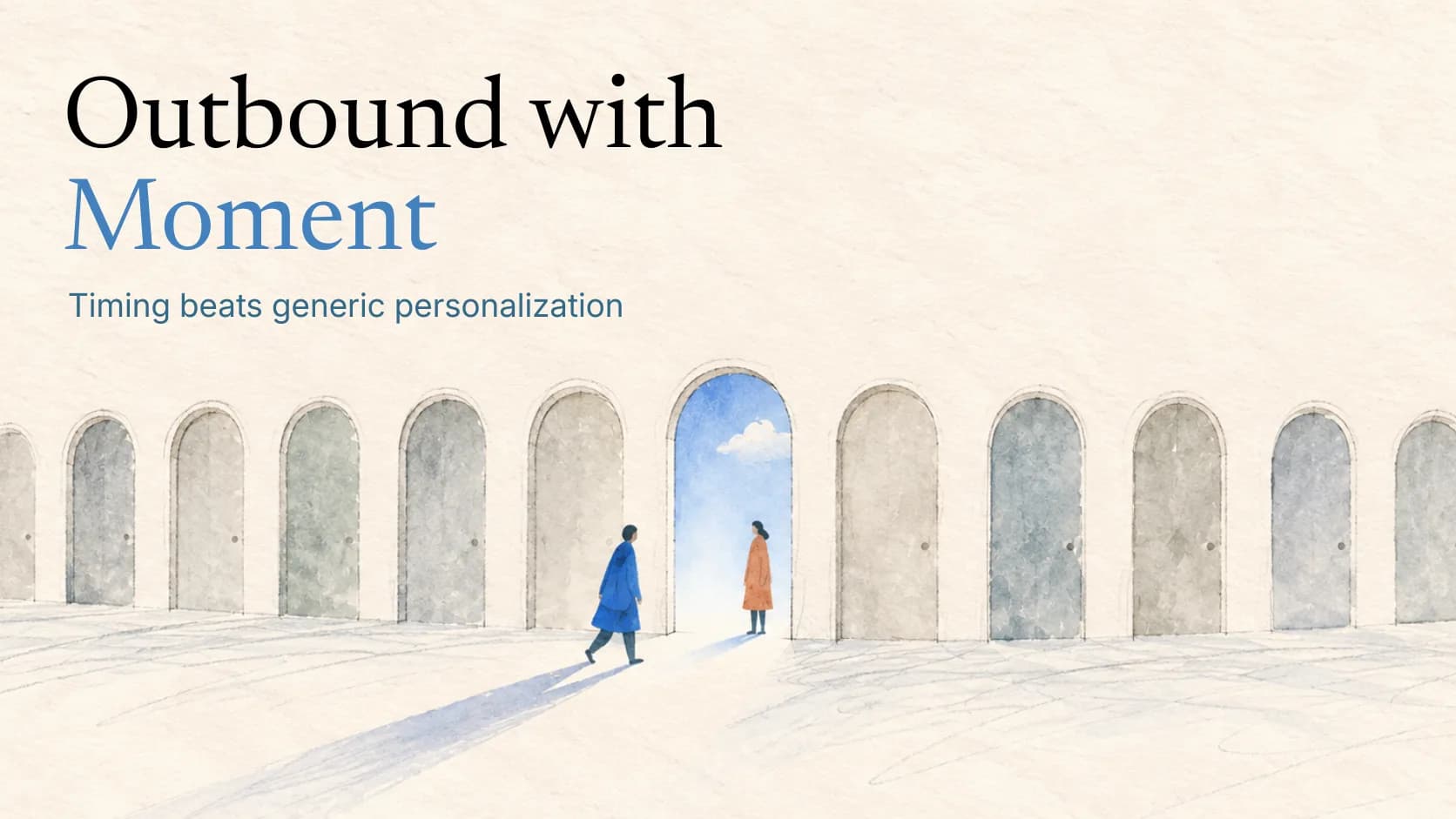
Two hundred leads. No software, no automation, just me watching. I picked people who matched our ICP and followed them across LinkedIn, Product Hunt, and X for weeks, not to pitch, just to notice. When something changed in their world, a launch, a new hire, a post that hinted they were actually looking, I reached out that same day. Nothing clever in the copy. Just timing.
200
leads, watched by hand
25%+
reply rate
~12
meetings booked
No list-blast gets close to that. I know, because I'd already tried the other way, personalized subject lines, first names, “saw your post” openers, all of it. The replies were fine. Not this.
We are building Outbird around the thing that actually changed the numbers. We call it the outbound moment.
What is the outbound moment?
The outbound moment is the narrow window right after something changes in a prospect's world, and before they've either solved the problem themselves or handed the decision to someone else. It's not a list. It's not a score. It's a specific point in time, and outreach sent inside that window behaves completely differently than outreach sent outside it.
Most outbound still runs on static lists. Someone matches your ICP on paper, so they get an email, this week, next week, whenever the sequence gets to them. The outbound moment approach flips that. The trigger isn't “do they fit,” it's “did something just happen.”
Why generic personalization stopped working
Here's the pattern almost every outbound tool calls “personalized”: a first name, a company name, and a line like “saw your recent post” or “noticed you're hiring.” It looks specific. It isn't. It's recognition without relevance, proof you glanced at a profile, not proof you understand what's actually happening for that person right now.
That gap is exactly why cold outbound has been losing ground. As more tools generate that same shallow layer of “personalization” at scale, prospects have gotten faster at spotting it, and deliverability and trust have both taken the hit. The sentence didn't get worse. The moment it was sent in stopped mattering to anyone writing it.
Not all signals are equal
Once you start paying attention to timing, the next question is which changes are actually worth acting on. Not every signal carries the same weight. An analysis of roughly a million B2B software purchases found a wide spread in how much different signals actually correlated with someone buying soon after:
Job posting surges are the signal every tool tracks by default, and they're one of the weakest on the list. Meanwhile something like recent AI tool adoption barely gets watched at all. The lesson isn't “track more signals.” It's “track the right four or five, and ignore the noise everyone else is chasing.”
How fast does the moment actually close?
Fast. Outreach sent within 24 hours of a real signal has been reported to perform roughly three times better than the same message sent a week later.
That's the entire argument for why this has to run continuously instead of in weekly batches. A signal caught on Tuesday and acted on the following Monday isn't late by a little. It's already cold.
What this looked like before Outbird existed
I didn't start with software. I started by watching. I'd pick a lead, follow what they posted, notice who they engaged with, and wait. Most days that meant doing nothing. Then something would shift, a launch, a hire, a comment that gave away they were actually looking for a solution like ours, and that was the day to reach out, not the day after.
The version of this that worked had nothing to do with clever copy. It was showing up on the one day out of sixty that actually mattered.
Outbird exists because I couldn't keep doing that by hand for more than a couple hundred people. The instinct was right. It just needed to run at a scale one person can't sustain alone.
The framework
- 01
Watch. Track your ICP across the places they actually show up, not just a database that updates once a quarter.
- 02
Wait. Most days, nothing worth acting on happens. That's fine. Resist the urge to reach out just to stay active.
- 03
Act inside the window. When a real signal fires, reach out that day, not that week, on whichever channel the person is actually on.
- 04
Follow through. A good message at the right moment still needs a real person on the other end of the reply.
Timing gets someone to open the door. What happens in the seconds after that, whether they trust what's actually on the other side, is a different problem, and it deserves its own answer rather than a paragraph tacked onto this one.
Read nextWhy the moment isn't enough on its own, and what it actually takes to not be a stranger when you reach out.